The Target Ship: The Story of the SS James Longstreet in Cape Cod Bay
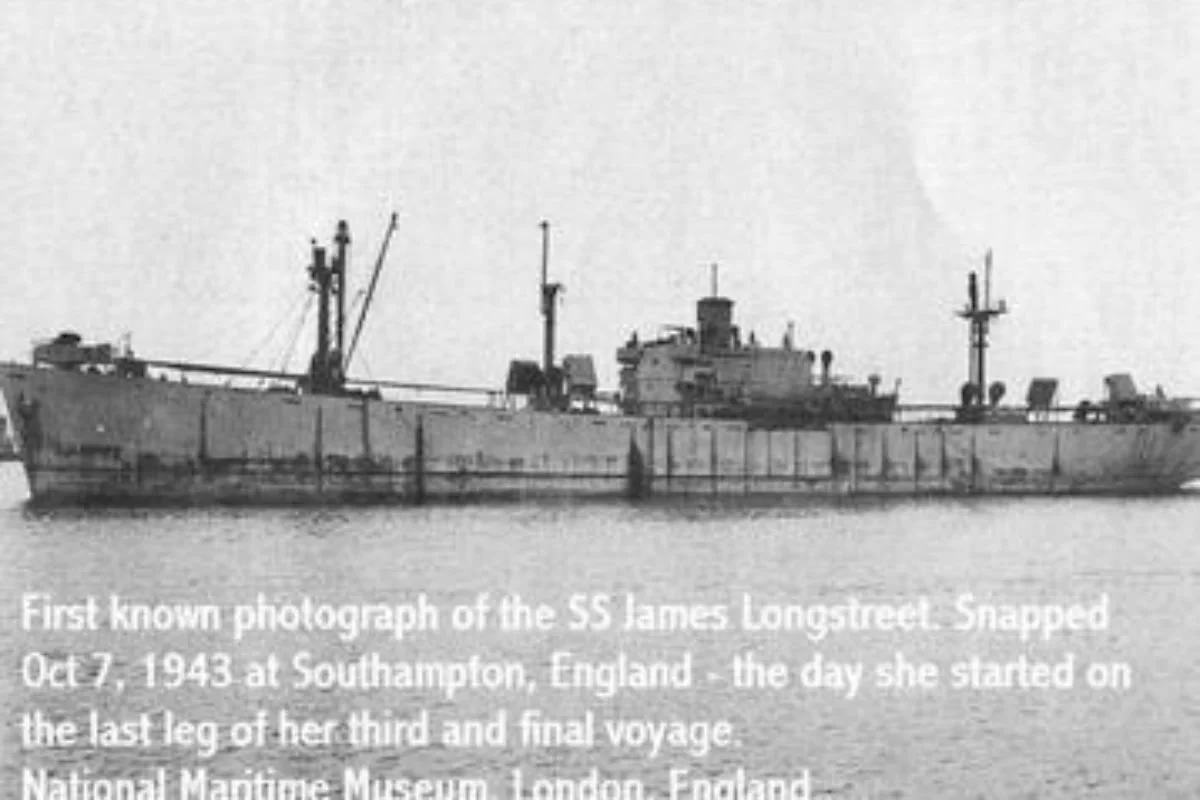
A few miles off the bayside beaches of Eastham lies one of the Outer Cape’s strangest pieces of maritime history.
The SS James Longstreet, better known simply as The Target Ship, was a World War II Liberty ship that eventually became a fixture of Cape Cod Bay. But before she ended up off Eastham, she had already lived through a remarkably chaotic series of events.
Launched in Houston in 1942, the Longstreet entered wartime service as a cargo ship. She made a long voyage through the Panama Canal and across the Pacific, reaching ports in Australia, India, and Ceylon. On the return trip in 1943, things began to go badly.
She collided with the British ship West Point, and not long afterward ran aground during a gale off Sandy Hook, New Jersey. The damage was severe enough that she began breaking up and was eventually declared a constructive total loss.
That normally would have ended the story.
Instead, the Navy took an interest in the damaged ship and acquired her for weapons testing. The Longstreet was used as an experimental target off New York, including work involving early guided bombs such as the Pelican and Bat.
Then, in late 1944, the ship broke loose from her moorings during another gale.
She was later found drifting at sea, recovered, and towed south.
Even after that, her troubles were not over. She was used for more bombing tests in Pamlico Sound, where conditions proved less than ideal, and she reportedly ran aground yet again while being moved between target areas.
Eventually, the Longstreet was assigned to Project Dove, an experimental weapons program involving Polaroid Corporation and the development of a heat-seeking bomb. That project is what finally brought her north to Cape Cod.
In early 1945, she was towed to Massachusetts and prepared for a new life as a stationary target.
In April of that year, the SS James Longstreet was deliberately grounded and scuttled on New Found Shoal off Eastham.
From then on, she became The Target Ship.
For decades, the remains of the ship stood above the water and were used for bombing and gunnery practice. Aircraft from the military would make runs over Cape Cod Bay, and people along the Outer Cape could sometimes see the flashes and hear the explosions from shore.
For some families, watching the exercises became a strange part of summer life. The rusting ship was such a familiar landmark that simply saying “the Target Ship” was enough for locals to know exactly what you meant.
Over time, Cape Cod Bay began to take the ship apart.
Salt water, storms, ice, and decades of exposure gradually reduced the wreck. A major storm in the 1990s submerged much of what remained, and today most of the Longstreet lies below the surface.
At very low tides, portions of the wreck may still become visible.
The area should still be treated with caution. Because the ship was used for live weapons testing for so many years, the possibility of unexploded ordnance remains, and boaters should give the site plenty of room.
What makes the SS James Longstreet so interesting is that her Cape Cod story is really only the final chapter.
Before becoming the Target Ship, she had already crossed oceans, collided with another ship, grounded in a gale, been declared a total loss, rescued for experimental weapons testing, broken loose and drifted out to sea, been recovered, grounded again, and finally assigned to a secretive wartime weapons program.
Then she ended up on a shoal off Eastham, where generations of Cape Codders came to know her simply as The Target Ship.
Today, almost nothing remains above the water, but the name is still part of the history and geography of Cape Cod Bay. For anyone who spends time on the water here, it is a reminder that even the quietest stretches of the bay can have some surprisingly strange stories beneath them.