Billingsgate Island: Cape Cod's Lost Village You Can Only Reach by Boat
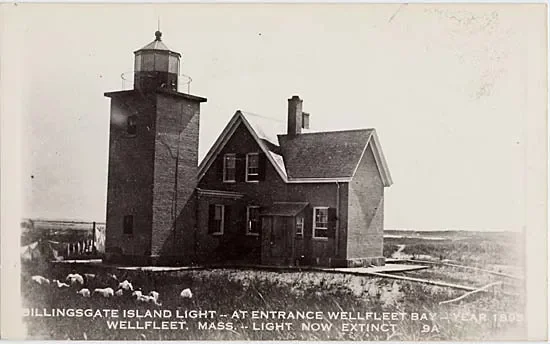
Billingsgate Island Light, 1895. The island and lighthouse were gone by the 1940s.
The Packet Boat | Wellfleet, Cape Cod
Two and a half miles off the Wellfleet shore, just south of Jeremy Point, there's a place that most visitors to Cape Cod have never heard of. At low tide, a sandy shoal rises out of Cape Cod Bay — scattered with granite blocks, old bricks, and shells. It doesn't look like much. But this is Billingsgate Island, and it was once a thriving fishing village with thirty homes, a lighthouse, a schoolhouse, and even a baseball team.
A 60-acre community, swallowed by the sea
Billingsgate takes its name from the famous fish market in London — fitting for an island that owed its existence to the sea. By the mid-1800s, the island was home to a seasonal fishing community of dozens of families. A lighthouse went up in 1822, only the second built on Cape Cod, and for decades it guided vessels safely into Wellfleet Harbor.
The shellfishing was extraordinary. One lighthouse keeper recorded that a crew of fourteen clamdiggers could haul thirty-five barrels in a single day. Fishermen pulled mackerel by the thousands. Whalers hunted blackfish in the surrounding waters — Henry David Thoreau wrote about a Billingsgate lighthouse keeper who found hundreds of blackfish stranded on shore and claimed every one of them before anyone else arrived.
But the island was always on borrowed time. Cape Cod's coastline shifts constantly, and Billingsgate was especially exposed. A catastrophic storm in 1855 split the island nearly in half. More storms followed. Residents began floating their homes across the harbor to Wellfleet on rafts — some of those "Billingsgate cottages" are still standing in town today.
By the early 1900s, only the lighthouse keeper and a shellfish warden remained. The lighthouse was destroyed in a storm the day after Christmas in 1915. By the early 1940s, the island was fully submerged at high tide.
Before the fishing village
The story goes back much further than the lighthouse. When the Pilgrims arrived in 1620, the area — then encompassing present-day Wellfleet and Eastham — was home to the Punonakanit people, members of the Wampanoag Nation. William Bradford described the island as "a tongue of land, being flat, off from the shore, with a sandy point." The Punonakanit fished these waters long before the European settlers arrived, and in 1757 they petitioned the colonial court to protect their rights to whale and harvest from Billingsgate after a settler tried to block their access. The court sided with them.
What you'll see today
Billingsgate Shoal is only accessible by boat, and only visible at low tide. When the water drops, you can walk on the sandy remnants of what was once a sixty-acre island and find bricks from the old lighthouse foundation scattered among the shells. It's a popular spot for shellfishing and picnicking — and one of the most unusual places on Cape Cod.
The Packet Boat passes by the Billingsgate Shoal on tours out of Wellfleet Harbor. It's one thing to read about Cape Cod's "lost Atlantis." It's another to stand on it.
Book a trip at thepacketboat.com